



By K. Richard Douglas
Cities, counties and rural areas around the world all have health care facilities that require the expertise of HTM professionals. This fact holds true from a health clinic in developing Africa to a small hospital in the rural U.S. to facilities in West Asia and the Middle East.
Within the Middle East region, the largest country is Saudi Arabia, known officially as the Kingdom of Saudi Arabia. The country’s capital and largest city is Riyadh.
Saudi German Hospital-Riyadh is a 300-bed multi-specialty tertiary care hospital that has been in operation since 2001. The hospital is comprised of two facilities: a main building and a medical tower.
The hospital has a four-member biomedical engineering department.
“Riyadh’s biomedical engineering department is manned by experienced technical staff. It is working with four employees that include two engineers and two technicians,” says Engineer Naveed Ahmed Khan, MBA, assistant maintenance manager.
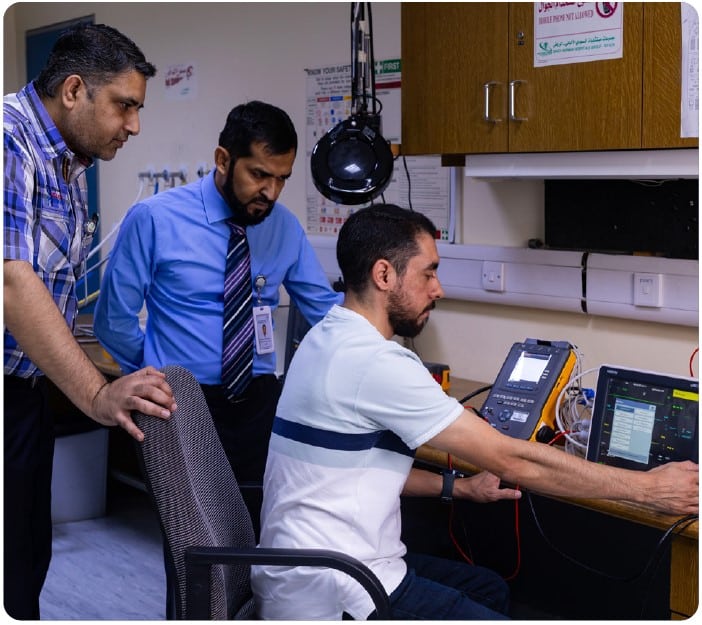
In addition to Khan, the department includes Engineer Ahmed Aljazani, B. App. Sci. Biomedical; Technician Shahjahan Afqar, Diploma Biomedical; Technician Muhammad Samir, Diploma Biomedical; FMS Director Engineer Abdul Rauf Bhatti, B.E. Electrical and COO Dr. Ramy Abouelkheir, Ph.D.
Khan says that the department provides appropriate and safe operation of medical equipment; from installation, incoming inspection to testing and repairing, preventive and corrective maintenance of diagnostic and therapeutic devices.
“The BME department also provides pre-purchase research and evaluation of new technology and equipment, recommends, and provides updates on equipment recalls and, as needed, sources data related to new equipment’s reliability and safety from outside the hospital,” he says.
Expansions and Moves
Although a smaller department, the biomed team carries out a number of duties in addition to PMs and repairs.
Khan says that the team also assists clinical departments with service contract analysis, negotiation and management. In addition, it provides coordination of clinical equipment installation including planning, scheduling and oversight.
He says that the department also participates in various committees like the daily operational committee, procurement, planning, and with the facility management and safety committees.
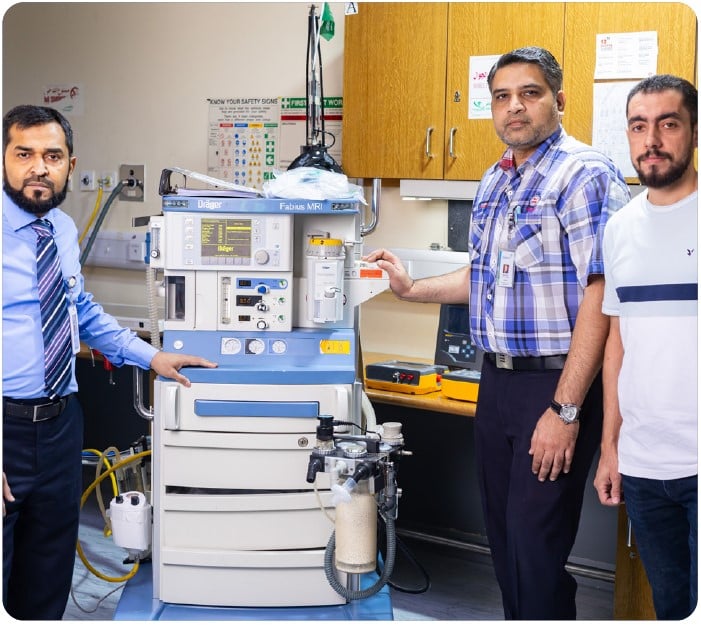
“[The team] conducts device incident investigations [and] reports medical device incidents to the Saudi Food and Drug Authority,” Khan says.
He says that they also provide training to clinical staff regarding the use of medical devices and monitor clinical staff for continuous compliance with the proper use and maintenance of equipment.
“Saudi German hospital also has outsourced service contracts for critical and high-tech equipment with companies like Siemens, GE, Philips and Drager. Biomedical department provides coordination and assistance to both service contractors and in-house users,” Khan says.
A few projects that the biomed team has been involved with include an ICU expansion from 14 beds to 38 beds in 2023, a NICU expansion from 35 beds to 57 beds, also last year, and ongoing work for future hospital expansion projects (e.g., hemodialysis, rehabilitation center, etcetera).
A previous project included the in-house development of a CMMS biomedical module with the WIPRO team. Khan was appointed to design workflow and to provide consultation for mapping with different areas like procurement, warehouse, finance and functions for break down, risk assessment, considering end-user requirements, documentation and reporting, according to requirements of the Joint Commission and other auditing authorities and standards.
“As overall expansion of hospital projects was running parallel to each other, LDR and NICU were transferred to a new expanded area on the second floor, the old NICU and LDR areas were emptied, and within no time, merged with the ICU. [The] ICU capacity was increased from 14 beds to 38 beds. [The] biomedical team participated from planning until installation and executed within the timeframe,” Khan says.
Last year, the outpatient department was moved from the main facility to the medical tower.
“[The] medical tower is built adjacent to the area of main hospital. [The] area between the hospital and tower is utilized for an ER extension. [The] tower has a total of six floors currently; five floors are utilized and fully functioning with 150 different specialties and subspecialties clinics. Most of the departments were equipped and ready for use even though many departments were transferred fully or partially by the biomedical department from main building to new medical tower,” Khan says.
The projects last year were only part of what the department has assisted in.
“Currently, two new projects are in progress; one is hemodialysis and the second is rehabilitation. There will be a specialized area for rehabilitation which will cover pediatric physiotherapy, speech therapy, occupational therapy, locomotion therapy and rehabilitation services for stroke patients,” Khan says.
He says that the hemodialysis unit is expanding from nine beds to 15 beds, which also includes two beds for hepatitis B patients.
The small team of biomeds has also been involved in problem-solving at their facilities.
“By monitoring daily breakdown requests, we found after the compilation of data that infusion pumps of [the] same brand [were] having common breakdown issues. We sent breakdown data to the supplier which they forwarded to the manufacturer, and after analysis, they replaced 26 infusion pumps. This kind of monitoring and root cause analysis helped resolve an emerging problem in providing safe patient care,” Khan says.
The department established the first in-house calibration lab for medical devices and it offers top class calibration equipment from Fluke Biomedical, with which they can perform electrical safety test, gas flow analysis, multi parameter monitoring testing as well as defibrillator testing.
“For this, we have been declared as a benchmark for rest of the Saudi German hospital branches by the group quality and patient safety department,” Khan says.
Beyond the work the team does in the two facilities, Khan says that the department is involved with the Saudi Engineering Council and Saudi Food and Drug Authorities in different activities.
