



By K. Richard Douglas
The Rio Grande Valley spans the southern-most tip of Texas and portions of northern Mexico. It is a river delta benefiting agricultural production. The population of the Rio Grande Valley is more than 1.3 million, with Hidalgo County (Texas) accounting for the largest portion. Two wildlife refuges, a state park and South Padre Island attract tourists to the area.
Many “winter Texans” travel to the area during the winter months to enjoy the temperate climate and Spring-breakers flock to South Padre Island on an annual basis.
This ebb and flow of the area’s population requires a robust health care capability. This demand is met by health care clinics and hospitals in McAllen, Harlingen and Brownsville, Texas.
Among the most important health care providers in the Rio Grande Valley is South Texas Health System. The multi-hospital system has facilities in Edinburg, Weslaco, McAllen, Alamo and Mission, Texas.
The system, or its facilities, are distinguished by a list of “firsts.” It includes the first facility to offer private behavioral health inpatient treatment in the Rio Grande Valley. It boasts the first neonatal surgery center in the Valley. It was home to the first designated Level II Trauma Center in Hidalgo County and the first and only freestanding hospital for children in the Rio Grande Valley.
South Texas Health System McAllen is a 441-bed hospital and was the first Level II Trauma Center for Hidalgo County. The hospital is now awaiting the State of Texas’ Level I Trauma Center designation after being verified as such by the American College of Surgeons. STHS McAllen is also a comprehensive stroke center and an accredited chest pain center. The hospital offers specialized services in maternity, neurosurgery, orthopedics and provides services to area veterans.
Four of the system’s facilities, McAllen, Heart, Edinburg and Children’s are equipped with helipads.
South Texas Health System is owned and operated by a subsidiary of Universal Health Services Inc. (UHS).
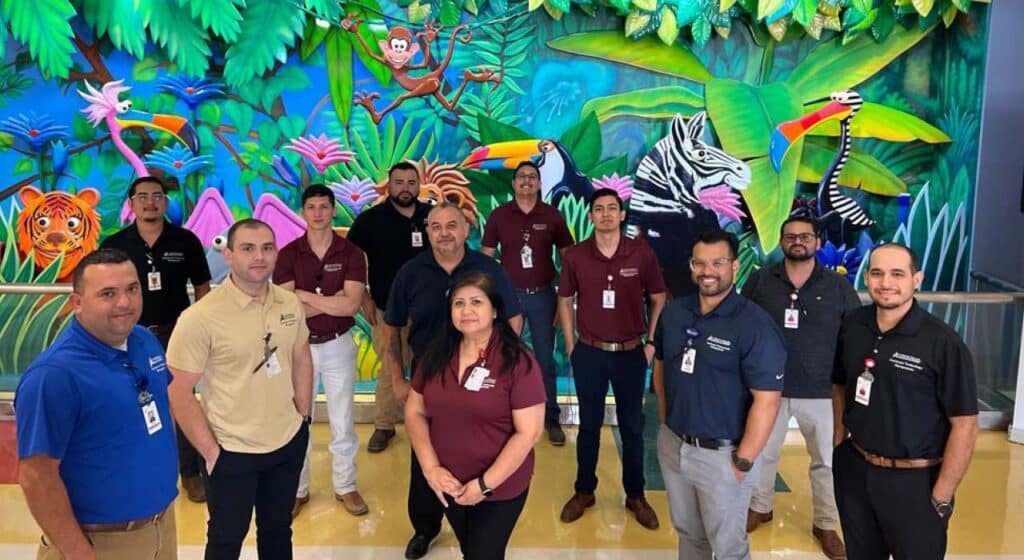
The system’s healthcare technology management department includes 13 members. The group’s director is Monica Garcia, CBET.
Other members include Senior Technician Hector Garza, CBET; Senior Technician Jose Garza, CBET; MSET III Antonio Garces, CBET; MSET III Joe Jackson, CBET; MSET II Christopher Rodriguez, CBET; MSET I Josue Lopez, CBET; MSET I Pablo Vallejo; MSET I Rogelio Tapia; MSET Miguel Gamboa; MSET Luciano Lopez; MSET Jeremiah Rodriguez; and MSET Omar Muniz.
Garza and Garces are imaging specialists. Jackson specializes in anesthesia and ultrasound. Lopez and Vallejo specialize in injectors and ventilators. Gamboa specializes in anesthesia. Garces also services heart/lung bypass systems.
The team manages surgical instruments and endoscope maintenance and repairs as well as managing pharmacy and laboratory fume hood, surgery trace gas analysis and generator annual boiler inspections.
The department also manages redeployment of medical equipment.
“HTM works alongside with IT and PACS for all EMR integration (imaging, ultrasound, infusion, monitoring and ECG),” Garcia says.
Bringing in Equipment for the Pandemic
The department has taken on projects related to an expansion and to address the challenges of the pandemic. It has also been involved in a large infusion pump project.
“HTM provides the system with life cycle report from our CMMS and assists with capital recommendations and PO requests. HTM rotates daily/weekly rounds in all departments and facilities. HTMs presence out in the patient care environment is vital to improve patient care,” Garcia says.
She says that the department supports operational planning via weekly hazardous surveillance rounds at all sites.
One current project is a new $100 million five-story tower (enhanced ER, ICU and rehab departments) at South Texas Health System Edinburg. The tower added 59 patient beds, 16 private treatment bays in the ER and 16 beds in the ICU. It has space for an additional 55 beds.
“HTM has provided support to UHS accounts; Doctors Hospital in Laredo, Fort Duncan Regional Medical Center Eagle Pass and Northern Sierra in Reno Nevada,” Garcia says.
The team has also been involved in a biomedical device integration (BMDI) infusion project. The task involved CareAware-Cerner Integration on BD Carefusion 2000 infusion pumps, software updates and QR code creation for each device.
“The infusion project continued with the 400 physiologic monitors and with the integration on 170 vital signs monitors Philips VS4’s and Masimo Roots,” Garcia says.
Garcia says that the first wave of the COVID-19 pandemic didn’t hit Hidalgo County until after the Fourth of July holiday in 2020.
“HTM worked alongside support departments with the startup of COVID-19 units with the relocation and programming of monitoring equipment. HTM managed the sourcing of over 2,000 rental and state-owned medical equipment (ventilators, physiologic monitors, patient beds, high-flow humidifiers, infusion pumps, etcetera) for our system’s three hospitals and included all our free-standing ERs,” she says.
Garcia says that since the onset of COVID-19, the department has added four full-time employees.
“In the last two years, HTM has shown a 53 percent reduction in contract costs by removing imaging,” Garcia says.
This biomed team in the tip of Texas keeps medical devices repaired and running in order to handle any challenge.
