



By K. Richard Douglas
The numbers are impressive; UT Southwestern Medical Center is a public academic health science center in Dallas, Texas, with approximately 23,000 employees, 3,000 full-time faculty and nearly 4 million outpatient visits per year.
The medical center has four degree-granting institutions: UT Southwestern Medical School, UT Southwestern Graduate School of Biomedical Sciences, UT Southwestern School of Health Professions, and UT Southwestern Peter O’Donnell Jr. School of Public Health
The institution has had six Nobel Prize recipients since 1985 and has been recognized as one of the top 10 best employers in the U.S.
The medical center’s 44-member healthcare technology management department manages an inventory of more than 45,000 assets spread across multiple counties in North Texas.
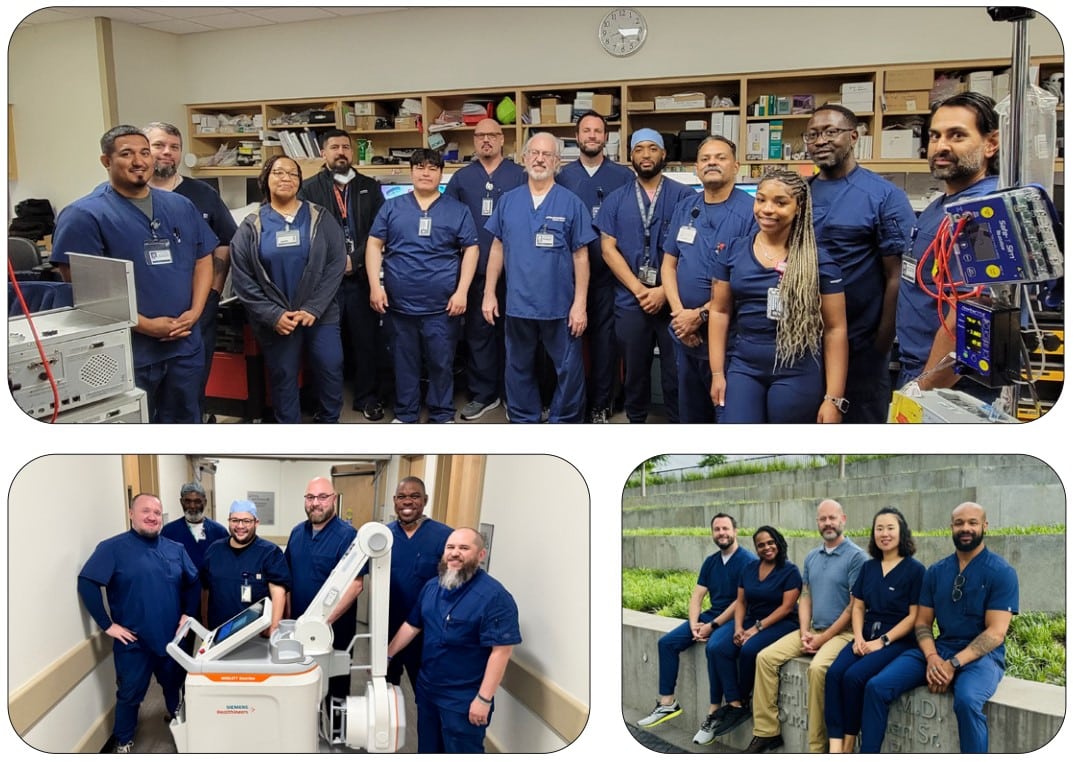
The team includes Director Josh Virnoche, AAMIF, CHTM, CBET; Imaging Equipment Manager Wes Pool, CHTM; Biomedical Manager Paul Stodolka, CHTM; Biomedical Supervisors Tim Wicker, Cory Williams, Josh Grams and Preston Gilstrap; Imaging Equipment Supervisor Tracy McCarthy; 18 biomeds, five imaging equipment specialists and a biomedical support coordinator. The team also has two part-time paid interns who serve as biomedical equipment assistants.
The large biomed team handles medical equipment management across 24 locations and two hospitals; including William P. Clements Jr. University Hospital, Zale Lipshy Pavilion – William P. Clements Jr. University Hospital, a cancer care outpatient building, along with 176 clinics and many others.
The triple-tower, 12-story Clements University Hospital and accompanying Zale Lipshy Pavilion features more than 820 beds and offers a complete range of emergency, specialty and surgical care in more than 80 specialties and subspecialties.
Virnoche says that the department has members assigned to dialysis, sterile processing, imaging, NICU and respiratory therapy.
“However, they still have responsibilities elsewhere, and while these specialty departments are a priority for them, they are able and expected to be flexible to the needs of the overall team,” he says.
The team recently completed a major reworking of its CMMS that Virnoche made a priority.
Big Projects
New construction can always present a big challenge to biomed departments, involving planning for installation, equipment choice, support and many other factors. In addition to its already large responsibilities, the HTM team has provided its expertise as the health care system has grown.
“UTSW is growing at an astonishing pace, and the HTM team has been involved in a significant amount of it. Much of the growth was prior to my time arriving, but we have much growth coming, as well,” Virnoche says.
He says that in the depth of the COVID-19 pandemic, UTSW was deep in the construction phase of a new tower connected directly to the existing hospital. The “Orange Tower” opened early in 2021, with significant work from the HTM team.
“Our technicians were vital in the testing and installation of all the new devices within the new space, as well as go-live support during opening. The expansion included a new 12-story bed tower, which included 291 additional beds to the 460 beds that already existed at Clements Hospital. In addition, an emergency department expansion was included, which increased the capacity by more than 50 percent,” Virnoche adds.
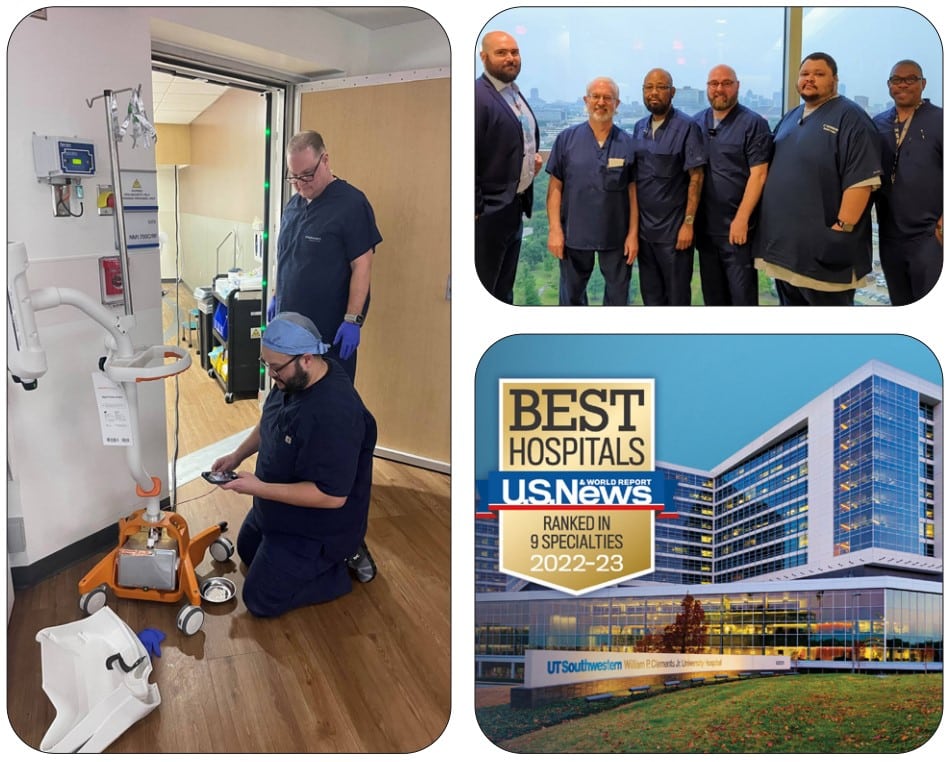
Additionally, the Harold C. Simmons Comprehensive Cancer Center opened on November 7, 2022.
“The new cancer center is home to new MRIs, infusions rooms, and facilitates UTSW’s multidisciplinary treatment approach, where all the various specialties a patient might need are located in a single building, rather than in different locations. The HTM team was instrumental in ensuring the equipment was installed, functional and safe to use prior to opening,” Virnoche says.
In the realm of problem-solving, the diverse team has delivered as well. Virnoche says that he feels like problem solving is what members of the HTM field are best at. He tries to involve the HTM team in everything to showcase their value.
“Our HTM team has been involved in everything from assisting with floods, to helping solve infrastructure problems that prevent our equipment from functioning properly. I think one of the greatest traits of BMETs is being the jack-of-all-trades and having to figure out how to resolve issues, in areas where they may have limited resources or knowledge,” he says.
“As I mentioned earlier, being an academic medical center, we have a unique organizational structure, and certain things that may seem like ‘not a big deal’ can quickly escalate to a ‘big deal’ here because of structure and budgeting. Typically, when we run into these situations, our team tries to ensure we are ready to support, as we kind of exist in a space that can work and exist between all of the ‘grey.’ We’ve taken the lead on facility infrastructure issues, plumbing issues, electrical supply issues, and ensure that we can be a source of trust for our customers in a situation where they may be frustrated or confused,” Virnoche adds.
He says the Zale Lipshy Pavilion (ZLP) is undergoing a $138.5 million renovation that will increase the number of beds from 74 to 130.
“Our team has been involved in taking equipment offline at ZLP and bringing it online in its temporary home here at CUH. There have been multiple phases of construction, while ZLP is under renovation, they have not stopped seeing patients. As we approach the end of the renovation, our team will reverse what we’ve already done, as well as install new, updated equipment into the space,” Virnoche says.
Beyond the major projects accomplished, Virnoche says that the future is bright.
“Currently, we are actively working on construction for a new psychiatric hospital. Governor Gegg Abbott approved $282.5 million in funding for the hospital, and our partner Children’s Health donated $200 million to support the pediatric wing, where UTSW pediatricians will exclusively treat children and adolescents. The facility will have 296 total beds, with 200 for adults and 96 reserved for pediatric patients. While our overall equipment footprint will be limited, due to the nature of psychiatric care, we will staff this hospital and ensure that the equipment in use in this new facility is maintained and functional for all those who need it,” he says.
Away from work, some of the team members are involved with the newly revitalized HTMA-North Texas biomed association (HTMA-NTX).
“Our local HTM association is currently going through a revitalization and, as such, one of our supervisors was selected as a membership chair for HTMA-NTX, and I was selected as the V.P.-Dallas. Our first social event will be happening in just a couple of weeks, and I’m excited to see all the work that the team has put into making it happen,” Virnoche says.
With continuous improvements in this HTM team, tasked with a massive inventory of equipment and big improvements to the CMMS implementation since Virnoches’ arrival in early-2023, the UT Southwestern Medical Center’s mission to “Educate, Discover, Heal” moves forward to the benefit of north Texas residents.
