



By K. Richard Douglas
While many biomeds go into some form of technical training or electronics right out of high school, others find the HTM field later in life. Some of those biomeds come out of a related field, with foundational knowledge in regards to understanding diagnostics, circuit boards or turning a wrench. Then, they pick up some specific training to enter HTM.
There are also biomeds who return to school several years after high school in order to pursue an HTM career. These individuals often make a more radical career shift and enter formal training, along with on-the-job training and some OEM-training.
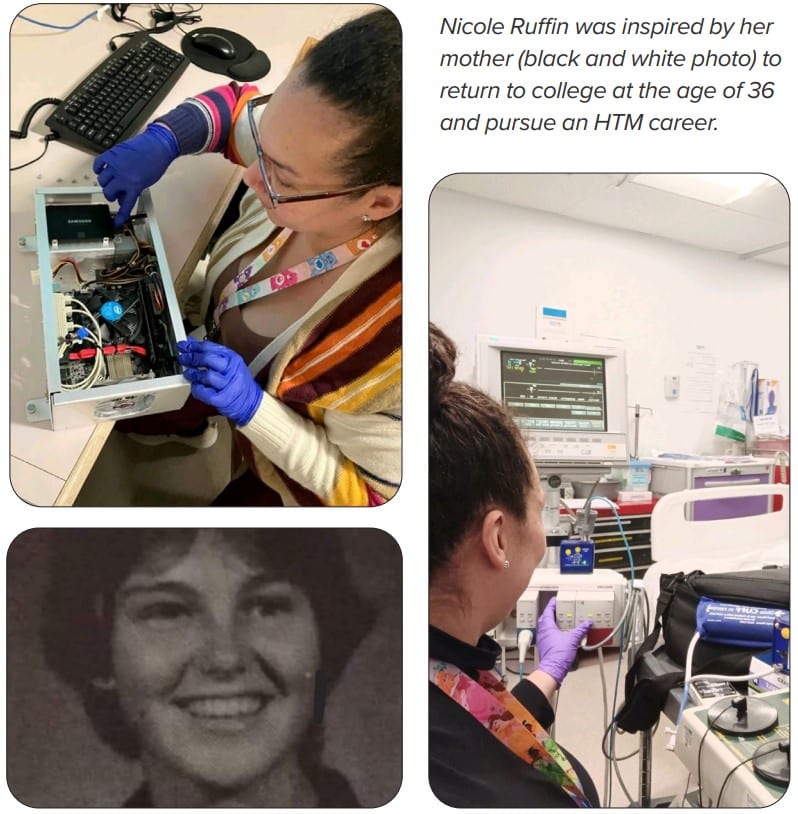
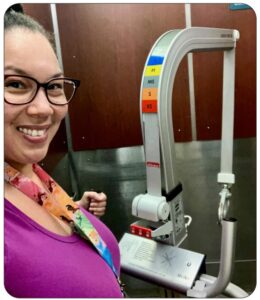 Nicole Ruffin is a clinical engineering technician with Crothall Healthcare. She works at Kent Hospital, as part of Care New England in Warwick, Rhode Island. She is among those biomeds who returned to school in their mid-thirties and began an HTM career.
“I have always wanted to work in the health care field, but I only saw nursing as an option. Once I learned about biomedical equipment technology, I jumped at the opportunity to return to college at the age of 36. Returning to school was also in honor of my late mother who always wanted me to go back to school. She herself went back to school at the age of 36,” Ruffin says.
Ruffin had some familiarity with health care; her sister works as a medical assistant and her father served as a medic in the Army National Guard.
She attended the Community College of Philadelphia in pursuit of an Associate of Applied Science degree with a concentration in biomedical equipment technology.
After earning her degree, Ruffin started her HTM career as an intern and was hired immediately afterward into a biomed role.
“I am currently in ultrasound training and interested in pursuing an imaging specialty,” she says.
Ruffin has more recently added some diagnostic imaging certifications to her credentials.
Determination
Some things that come along with a biomed career don’t necessarily get taught as part of technical training.
“A special challenge I have encountered as a biomed is identifying how far to go on a project before pausing and coming back to it. I sometimes get hyper-focused on a project and want to finish a project the same day,” Ruffin says.
Apart from her more routine assignments, Ruffin says she has worked on special projects including software updates on ST80i stress testing systems, replacing lead shields on a Luminos Agile Max and performing high-priority corrective service on a sterile instrument washer.
While at the Community College of Philadelphia, Ruffin made the academic honors list.
Off the job, her interests include driving, cooking, baking and singing.
Just as she proved by going back to school in her 30s, Ruffin’s philosophy is “never give up.”
“And, I hope my career serves as encouragement to others. We all have a place to serve our communities, in the HTM field. If we have a thirst to continue to learn, we will always win. Never give up,” she says.
The person who nominated Ruffin as a professional of the month stated, “She is new to the industry, but she has made an impression on everyone she has come in contact with.”
Even with a late start, Ruffin’s commitment to HTM makes her a valuable member of her team.
BIOMETRICS
Favorite book:
Any R.L. Stein book from “Fear Street” to “Goosebumps”
Favorite movie:
“Labyrinth”
Hidden talent:
I played the alto saxophone in grade and high school. I earned the place of second chair in concert band and played in the marching band. And as a nod to my mother, she was the lead drummer in her high school marching band.
Favorite food:
Sushi
Favorite part of being a biomed?
Learning something new every day.
What’s on my bench?
Gloves, Pronk bag, PM work list, Goo Gone and equipment stickers
