



By K. Richard Douglas
It was a judge’s decision in 1947 to appoint a commission to study the feasibility of building a second county hospital in Fayetteville, Arkansas. The following year, a design was completed and the new 50-bed hospital opened its doors in 1950. In 1973, after expansion and two name changes, the hospital became the Washington Regional Medical Center. In the decades ahead, the hospital expanded, modernized and other facilities were added.
The medical system’s biomed department manages medical equipment at the 425-bed acute care medical center in Fayetteville and more than 45 primary, specialty and urgent care clinic locations across the region.
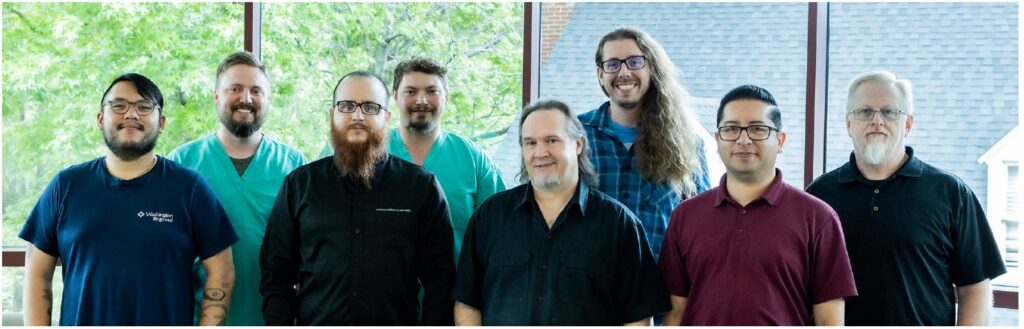
The nine-member biomed team includes Biomed Manager Samuel Deaton, one imaging equipment technician III, one BMET III, five BMET IIs and one BMET I.
The team lends its insights, in concert with its clinical counterparts, to decisions about service contracts.
“Service contracts are heavily dependent on the capabilities of the biomed department; if we have the ability to take on the maintenance responsibilities for a piece of medical equipment, then we will seek to do so. This is done in collaboration with department leaders of the areas where the equipment is used to ensure their service needs are met,” Deaton says.
He says that letting a service contract lapse can often be seen as a loss of service overall, so it is the biomed department’s responsibility to make sure that service is maintained or improved over what the vendor can provide.
In addition to service contracts, the department works with its colleagues in IT/IS to coordinate services.
“We have a very high level of biomed/IT integration. Our CIO has been the executive leader over our department since 2016, and that has led to a much closer tie to our colleagues in information services. We are at the point now that we are looking into creating a new healthcare technology information analyst role within the biomed department to bridge equipment service and information service,” Deaton says.
Returning In-House
The biomed team returned to in-house status after being outsourced for a time. The team self-evaluated every aspect of its service offering as it re-established itself as an in-house operation.
“One of our larger special projects involved the biomed department directly. A few years ago, our team was managed by an ISO. The decision was made in 2020 to transition back to being a fully in-house team. The transition happened in October of that year, bringing all of the managerial, policy, software and service changes that entails along with it,” Deaton says.
He says that while the biomed team was excited by the prospect of being in-house once again, it had a long road ahead to make it back to stability.
“We were essentially starting over from scratch, building the department from the ground up. The transition was a chance to scrutinize every aspect of our operations and try to make improvements that were rooted in the shared experience of the team. That started with a review of our service workflows, which we could then integrate into our CMMS during its implementation,” Deaton says.
He says that from there, it expanded to policy updating and review, which often involved other clinical departments, redesigning the technician job descriptions and how career paths advanced and becoming a part of the capital equipment process so that the team could leverage its knowledge to help guide the organization into the future.
“All of those changes have contributed to the department’s rapid growth. We recently brought on a new team member dedicated to clinic service operations, a must since our clinic locations span almost 100 miles. We have been building up an imaging technician team, investing in some of our current staff who have been interested in training on imaging modalities under the supervision of our imaging technician III. We have even been so involved with our peers in information technology that we are on the cusp of creating a new blended biomed/IT position,” Deaton says.
He says that making sure the transition was successful was a challenge, but in many ways a welcome one.
“I feel like that success can be easily seen, as well. You only have to look as far as our December 2023 Joint Commission survey, which we passed spectacularly. There is always more work to do, and we are making plans for what the next few years will bring, but if it is anything like the last few it will be more than worth the effort,” Deaton says.
The refreshed department faced down an equipment shortage situation, maintaining compliance and supporting patient care, while coordinating with its clinical counterparts.
“Every January, we perform PMs on all of our infusion pumps. That is nearly 700 assets that we have to touch, and it takes our whole team to get through the month successfully. We purposefully leave January empty of other scheduled PMs so that we can apply as many team members as possible to the effort,” Deaton says.
He says that January 2024 opened with an atypical problem: due to a myriad of serviceability issues, they were in a position where nearly 10 percent of the infusion pump inventory was out for repair.
“This stacked up quite suddenly, and unfortunately coincided with the month that we would need to keep a group of them out of service to be rotated during testing. We quickly ran into pump shortages, and it became clear that something would have to change dramatically if we wanted to both provide for our clinical teams and meet our PM completion goals,” Deaton says.
He says that working with hospital leadership, the biomed team coordinated the delivery of nearly 40 loaner devices to provide relief from the shortage. Keeping in touch with individual departments and their clinical managers, they then set about performing PM trade-outs.
“It was a daily struggle to ensure that we could maintain enough momentum to still hit our Joint Commission-mandated PM goals while also keeping enough assets in service that we would not be putting a burden on patient care. The team walked that line brilliantly, keeping open lines of communication, pushing a staggering PM pace and eventually completing one of the most successful infusion pump maintenance years that we have had to date,” Deaton adds.
He says that the level of teamwork that the biomed team displayed, not only within the department but interdepartmentally, remains inspiring.
The biomed team at Washington Regional has met the challenge of rebuilding its department and excelling in the process. As the nominator of this department stated, the team members have “created a high-level roadmap for their journey to world-class performance.”
