



By Conor King Devitt
Any tourist ferrying between ports or taxiing through the hills of the British Virgin Islands (BVI) will witness a montage of imagery that may seem like the very substance of a 9-5 commuter’s daydream: anchored catamarans, beachside cocktail shacks, turquoise-colored bays, and many tanned hands holding tumblers filled to the brim with Caribbean rum.
What that quick series of images will not capture, however, is the flip side of island life, the required resilience of a population living in geographic and communicative isolation.
Things simply take longer in the Caribbean, and because of that, professionals across different fields here have had to develop a certain level of wiliness. In the BVI, scrappy problem-solving ability is not something just written about in a cover letter; rather, it is the necessary skill of a day-to-day existence beset with endless inconveniences and delays.
Nowhere is that creativity exercised more than in the four-person biomedical engineering department at BVI Health Services Authority, the medical body that manages Tortola’s Peebles Hospital and 13 other clinics throughout the British Overseas Territory.
“We have a good team here. In our department, as in facilities and biomed, we have a high staff retention,” said Kaream Pickering, biomedical engineer and manager of the department. “The guys that are with us are with us for a lengthy period of time.”
Originally opened in the capital city of Road Town as a two-room facility in 1922 and referred to as the Cottage Hospital, the territory’s main medical facility was eventually renamed after its founder, Major Peebles, according to BVIHSA documents.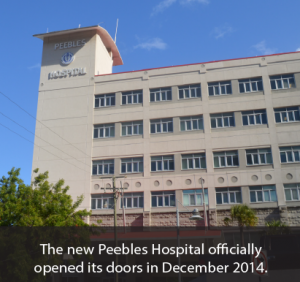
In December 2014, a new seven-floor, 151,000 square feet expansion officially opened. The 120-bed facility cost more than $100 million and features three operating theaters, one procedure room, and three labor and delivery rooms.
With that expansion came a gigantic increase in the number of medical machines and the need for a capable biomedical engineering department to maintain them.
BVIHSA’s team is broken up into two units; Pickering and Candia Thompson, a biomedical engineer, form the general department. Delton Turnbull and Jared Penn are the authority’s dialysis technicians. Most of their work is done at Peebles Hospital and the Iris O’Neil Clinic on the sister island of Virgin Gorda.
In addition, the BVI’s government brought a national health insurance program on-stream in January of this year, increasing the number of patients and the amount of the hospital’s equipment that is used, according to Franka Potter, marketing and communications director at BVIHSA.
Unique Challenges
When asked what the greatest challenge is working in the island environment, Pickering said, “Parts. The delay in parts. Especially depending on the company you’re dealing with and the kind of contract you have.”
With FedEx, parts typically take twice as long to arrive as they would in the continental U.S., Pickering explained. Shipping through general freight often causes delays of a week or two.
Both Pickering and Thompson mentioned technical support as another major challenge.
Because the BVI is outside of the United States, some companies cannot legally provide them with technical support, Thompson said.
They are often rerouted to Puerto Rico for support, which can cause difficulties due to the language barrier, according to Pickering.
As a well-experienced team, however, they have developed strategies over the years to combat their geographic challenges, he explained.
They stockpile broken equipment to part-out still-functioning elements, recycling broken dialysis machines, infusion pumps, monitors, defibrillators, ECG machines, ventilators, and much more. They also bulk-order equipment they know breaks down often and takes a while to reach the territory.
This does not mean, though, that they take any chances with machines.
“I don’t guess when it comes to medical equipment,” said Pickering, who trained at Memorial Hospital West and Prestige Biomedical, both in South Florida. “[Where] I trained, the guy told me, ‘Always deal with a piece of equipment as if you or any of your family members were getting care from it.’ So I don’t guess.”
The frequent lack of technical support has forced them to become more familiar with the service manuals for different pieces of equipment, increasing their depth of knowledge on the machines, Pickering said.
“Sometimes it makes you a better engineer, because now you have to figure it out yourself,” Pickering explained. “You have your manual and your book, and now you have to sit and go through every step, by yourself, versus calling [for technical support] and they’ve seen this problem probably 200 times.”
Pickering and Thompson work on everything that does not require a separate certification, including devices like vital signs monitors, sterilizers, centrifuges and laparoscopic equipment. BVIHSA contracts maintenance for diagnostic imaging equipment, lab equipment (besides the centrifuges), and anesthesia machines, largely on an annual basis through the Miami-based Biomedical International Corporation.
Turnbull and Penn maintain the hospital’s 11 dialysis machines, which are notoriously temperamental.
“You have 11 different machines, you could have 11 different problems,” Penn said.
They keep detailed notes on each individual machine to prepare for any future issues, Penn explained.
Group effort
Both Pickering and Turnbull stressed how important it is for their team to develop a variety of skills, especially in the context of their isolated location.
“We always try to cross-train everyone so we’re not always dependent on one person,” Pickering said.
Turnbull mentioned how they work with and learn from the BVIHSA’s electricians, plumbers, air-conditioning technicians and other maintenance department employees, just in case someone is on vacation or sick and anyone needs a helping hand.
