



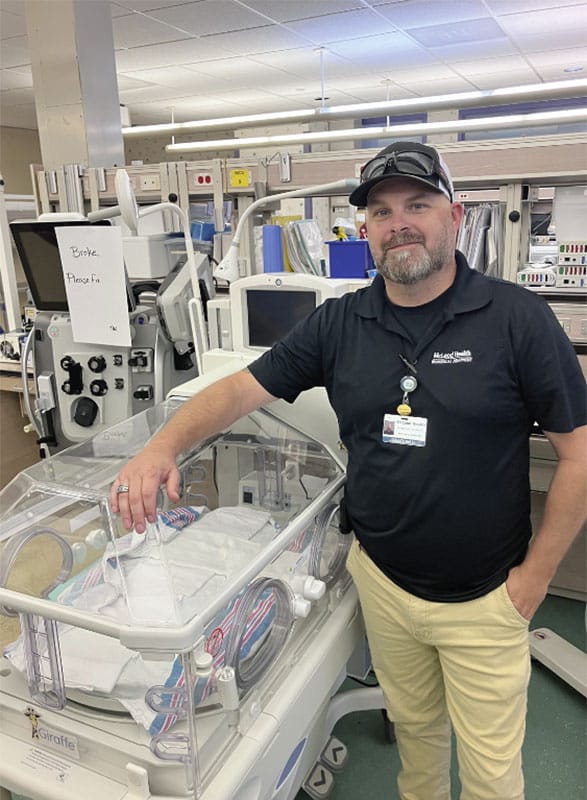
By K. Richard Douglas
The U.S. economy impacts people in many ways including a higher cost-of-living, the ability to buy a house or a rising or falling stock market.
It can also lead some people to the HTM profession.
“I became interested in the biomed profession when I was between electrical jobs. I was doing electrical work, but when the housing market crashed in 2008, very few homes were being built and very few electricians were needed, except for service calls, which was no longer steady work,” says Jonathan Hatley, CBET, technical manager, biomedical services, McLeod Health in South Carolina.
He says that he held out for about a year before he had to find another means for steady work. A friend helped him get a job at a place that makes and sharpens saw blades for giant sawmills found in North and South Carolina.
“I was the delivery driver, and I hated that job, but it was work. The saws can be quite large, some with a diameter of six feet; they were very heavy, it was hot in the summer, cold in the winter and I bled on a daily basis,” Hatley adds.
He says he worked at that job for a couple years, and during that time, he met with a guy through his father-in-law who said he was a biomedical equipment technician.
“I was like what’s that? He asked me, ‘Have you ever thought about what happens when equipment breaks in the hospital? It’s all machines, they break sometimes and need maintenance, and don’t you perform maintenance on your car by changing the oil periodically, your lawnmower or other things to help prevent them from breaking?’ As we talked, I found that the job mostly consisted of troubleshooting problems with equipment, repairing those problems, performing maintenance and customer service; all of which I was good at. My thoughts were that as long as hospitals are open, there will always be a need for people like him to repair equipment. I could do that,” Hatley says
He enrolled in the biomedical equipment technology program at Stanly Community College in Albemarle, North Carolina.
Hatley worked his way up in the field from a BMET I to entering his current position as a technical manager of biomedical services in 2023.
STRATEGIC MITIGATION
In the challenges/projects department, Hatley says infusion pump remediation stands out as a task that requires an understanding of patient flow.
“As manager for the biomedical department, I am involved in many projects, some of them over a year out. By far, some of the toughest projects that I have led, and been involved with, are the infusion pump remediations. They seem to happen every couple of years by a certain OEM. It is far more challenging than a project that only involves a single department because it involves every department in the hospital,” he says.
Hatley says that each time it is difficult because of the sheer volume of devices that have to be found and swapped out across each of the facilities; usually simultaneously.
“It takes great coordination between biomed and nursing staff, as well as the vendors to see that each and every aspect of it is calculated and purposeful. We can’t take too many devices out of service at one time without having new/replacement devices to fill their place. Because it usually takes a week or more at the main hospital, we can’t bank up devices in the evening to have for swap out the following morning because it will cause a shortage on the floors for the night staff and the on-call biomed would get called non-stop throughout the night,” he says.
Hatley says that during the remediations they rely heavily on nursing staff to help swap the devices that are in use on patients.
“We have to circle back through the same departments multiple times because patients are always moving, and new patients are always coming in. That’s why it helps to understand patient flow and having a good working relationship with the nurses and nursing administration,” he says.
Away from work, Hatley enjoys the simple things in life.
“Grilling, smoking meat and cooking food is a hobby that I have had for many years. I have three kids and a wife, so my hobbies mostly revolve around and benefit them. Mowing grass and lawncare is also a hobby because it’s the only time I am left to my own thoughts without interruptions. Other than that, I like to collect antiques,” he says.
Hatley says that his wife and he have been together for 16 years and married for 11 and they have three kids together; two girls ages seven and six and a boy who is three.
Hatley’s efforts received recognition from his employer.
“In 2018, I received the McLeod Merit Award, which is only given out to about four recipients per quarter in our organization and I am very proud of it. It is ‘For consistently exceeding the standards of excellence and quality set by McLeod and demonstrating cheerful and compassionate service to others,’ ” he explains.
It was well-deserved for this HTM professional who has been in the field since 2011, obtained CBET certification in 2018 and worked his way into leadership. The field is better with people like this.
BIOMETRICS
Favorite book:
I still read the Goosebumps original set. I’m a ’90s kid.
Favorite MOVIE:
“Back to the Future” and all the Marvel movies and “Tombstone”
Favorite FOOD:
BBQ
Hidden talent:
When I close my eyes, I can make people disappear until I open them again.
Favorite part of being a biomed?
Although my calling is not direct patient care, I take great pride in being able to provide comfort to staff and patients by using my skills to give them assurance by letting them know i am here to support them in their equipment needs, and in most cases, we can fix it if it breaks.
Why do you read TechNation?
TechNation is a great magazine for the biomed career field that provides useful and insightful information about products from vendors and different perspectives from biomeds across the country. I also enjoy the webinars hosted by TechNation on Webinar Wednesday.
Professional of the Month Nomination
