One of the leading health care providers in Tennessee is Erlanger Health System in Chattanooga. It is a part of the Vanderbilt Health Affiliated Network.
Erlanger Health System covers a 63-county service area, as well as the tertiary care facility central to the area’s Regional Trauma System covering Tennessee, Georgia, Alabama and North Carolina. The system includes seven hospitals. Erlanger Health System includes southeast Tennessee’s only Level I Trauma Center.
According to the system’s website, “We are a nationally acclaimed, multi-hospital health system anchored by a leading academic medical center.”
The system’s clinical engineering department includes several professionals who maintain the system’s inventory of medical equipment.
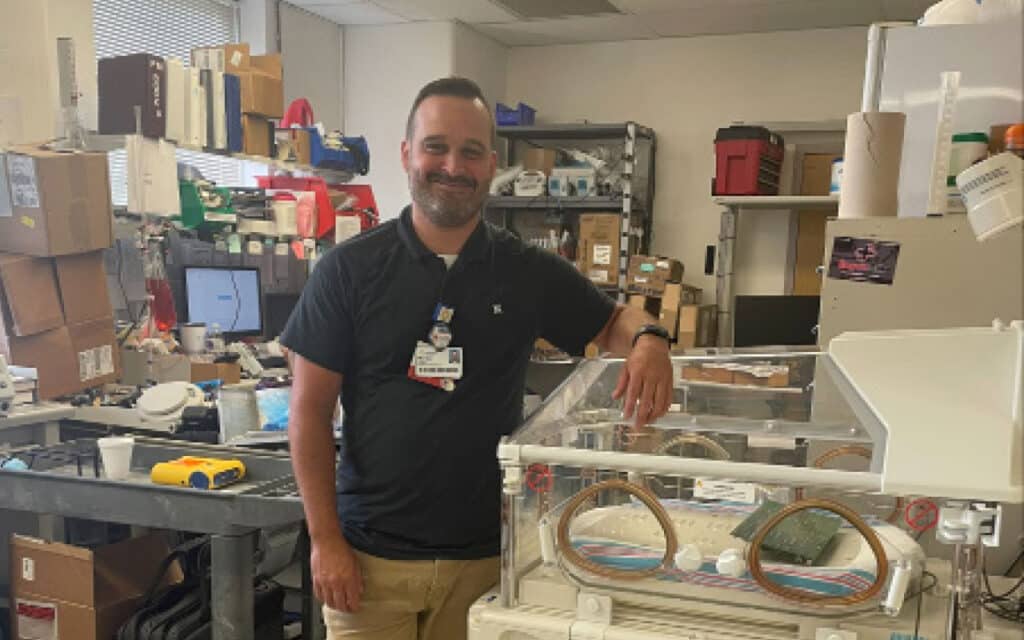
One of those professionals is Morton Campbell, Imaging Specialist I.
The person who nominated Campbell for professional of the month said, “While he currently specializes in imaging, he began as a general biomed. He will jump in to help any teammate out whether it is specific to imaging or one of his earlier skills. He also mentors new hires, bringing out their skill set and encouraging them along their new career path.”
Campbell is a military-trained biomed who received instruction in imaging and general biomed.
“I had a good friend/mentor in the military reserves, who was in the BMET profession. He spoke highly of the career and the training that he received from the military. My unit was closing due to reorganization of our ‘combat hospital’ and I was offered to reclass into BMET since my previous job as a radiology tech was unavailable,” Campbell says.
Campbell went through the Biomedical Equipment Specialist Program with the U.S. Army, located at Fort Sam Houston in San Antonio, Texas.
“It is a 41-week training program that covers basics for servicing and maintaining all medical equipment with mechanical, hydraulic, pneumatic, electronic, digital, optical and radiological principles. We were taught to troubleshoot and isolate malfunctions to a board level, and how to repair and replace defective components,” he says.
Campbell has the background to wear multiple hats when it comes to medical equipment repair and maintenance.
“I held a BMET Tech level 1 for approximately six months and transitioned over to the Imaging Specialist 1 role due to my background as a radiology tech in the Army Reserves; seemed like a better fit and the path I wanted in my career. I am currently the primary tech for our ultrasounds,” he says.
Identifying TEE Probe Issues
In terms of challenges, Campbell had to get up to speed when first tasked with handling ultrasound duties. He had good support throughout the process.
“I would consider a fast-learning curve, when I started, we had two techs to handle ultrasounds, shortly after I switched over to imaging specialist, I primarily was handling maintenance and service calls, by myself. I have had excellent support from the more seasoned imaging techs to lean on and help from third-party vendors. I currently handle over 170 ultrasounds throughout the Erlanger Health System,” he says.
In addition to more routine duties, Campbell has helped resolve some big issues.
“During the last year, I was repairing TEE probes at an unreasonable rate in our cardiovascular OR. I went down and started to talk to the staff to understand what the cause could be. I was able to identify the main issue was how the probes were being stored in a ‘dirty’ state and [a] secondary issue was [that] training on TEE probes was nonexistent,” he says.
Campbell was able to work with the department head to acquire a storage cabinet to store the probes prior to disinfection, and worked to get a third-party vendor to come to the hospital and train staff in the ECHO and CVOR departments on the handling of TEE probes.
“Since this was completed, staff members have been able to identify issues with TEE probes that normally would not have been addressed until it was too late and the probe was damaged beyond repair. We have dropped our TEE probe repairs by more than half and the need for replacing TEE probes is down substantially,” Campbell says.
When not on the job, Campbell enjoys hiking, camping and riding his motorcycle.
He gives the credit for much of his success to his employer and colleagues.
“My success, that I have found in this career, reflects the Erlanger Clinical Engineering Department. Since I started, I have received support, training and mentorship. The senior techs have always been willing to share their knowledge and help in teaching. Without their help, this job would be a lot more difficult to navigate and accomplish my work,” Campbell says.
With great on-the-job support, this imaging tech has become a great resource to his department, making it a two-way street.