By K. Richard Douglas
Founded in 1870, Ohio State University (OSU) was first known as the Ohio Agriculture and Mechanical College. Today, OSU is nationally known for its NCAA Division I sports teams, its research and its endowment.
The university has a college of medicine and operates both cancer and heart hospitals. Its two primary teaching hospitals include the Ohio State University Wexner Medical Center and the Nationwide Children’s Hospital. Both are nationally ranked.
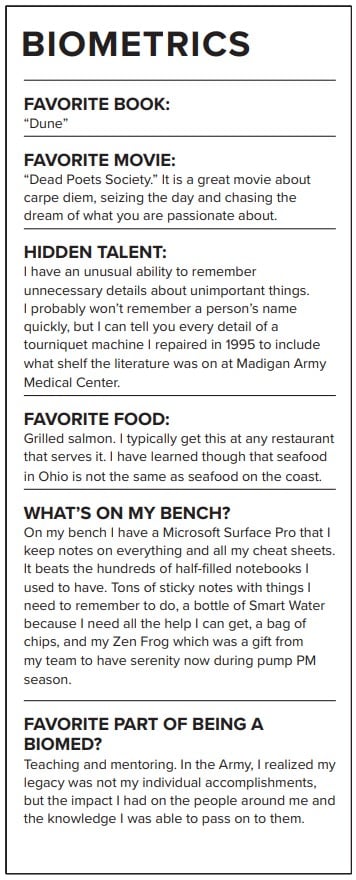
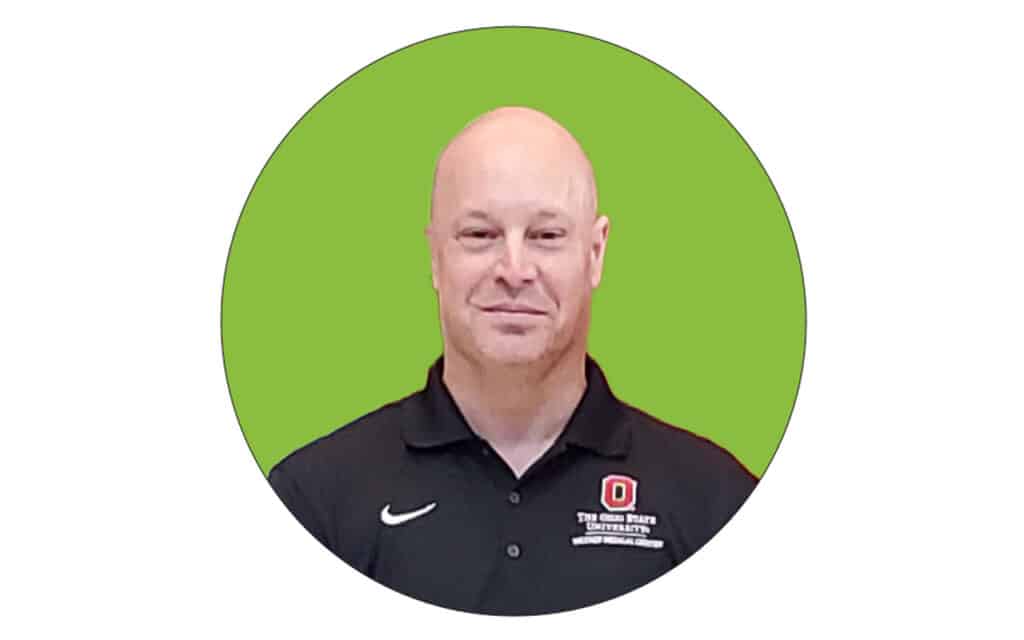
Richard L. Roettger, CHTM, CBET, is a manager in the OSU Wexner Clinical Engineering Department. When Roettger first considered the field, he didn’t even know that biomed was a career choice.
“Originally, I had no clue that this was even a career field or that medical equipment even broke or required regular maintenance. My senior year of high school, I went to enlist in the United States Army. I wanted to do anything with computers; primarily computer programming,” he says.
Roettger says that the liaison plugged his test scores into the computer and began showing him jobs that he qualified for.
“When Biomedical Electronics Technician popped up, the liaison got very excited talking about the job and that it was rare that it even came up, especially for a high school student. She showed me an old 1970s video on what the job and training entailed. It was definitely a career field I could do once I left the service, so I enlisted as a 35G Biomedical Equipment Specialist,” he adds.
Like many biomeds, Roettger received his training in the military.
“My formal biomed training was at Fitzsimmons Army Medical Center at the United States Army Medical Equipment and Optical School (USAMEOS). I was in Class 02-95G, which started in October of 1994. We started with 17 soldiers and two Navy sailors. We graduated in September of 1995 with 19 freshly minted biomedical equipment technicians, but only about 50 percent from the original starting class,” Roettger remembers.
He says that back then, they would actually build circuits on a bread board and then test them out in normal operation and then introduce failures to see how it affected readings on the multimeter and oscilloscope.
“I was fortunate enough in 2004 to go back and be an Instructor at the Tri-Service School at Sheppard Air Force Base in Wichita Falls, Texas,” Roettger says.
Today, Roettger manages the clinical engineering department for five hospitals and 16 technicians.
Big Project Makes for a Learning Experience
Roettger is involved in a building project; a 25-story smart hospital which is scheduled to go-live in 2026.
“This project started about five years ago with just a concept and many brainstorming sessions, with what a hospital of the future should be, and how we could leverage technology to meet the needs of future patients,” he says.
Roettger says that the project received input from various departments and employees from clinicians to support staff and even patients on current challenges and what would make their experiences more enjoyable.
“It has definitely been a learning experience working with project managers and designers to ensure clinical engineering’s needs are met so we can best support all the medical devices in the new hospital but also working with clinical leadership to understand their work flows and ensure that equipment selections and building layouts meet their needs as well. The greatest challenge I have had is reviewing architectural drawings to ensure things like network drops for the patient monitoring network are captured,” he says.
He says that the project is the largest project he has ever worked on.
“I am looking forward to the final stages of this project and actually installing and validating all the new medical devices for this new hospital,” he adds.
Roettger says he has two amazing children. His daughter, Makayla, is part way through her sophomore year at OSU studying criminology.
“My son, Noah, is starting his sophomore year in high school, where he has been taking an engineering college course. He currently wants to be an aeronautical engineer,” Roettger says.
Away from the workplace, Roettger enjoys watching movies and listening to music and collecting both.
“I think I have owned ‘Star Wars’ on every media format known to mankind. I love spending time with my kids and engaging in activities and interests they have,” he says.
He says that the success he has had in HTM has not been an individual achievement.
“I have always been surrounded by amazing technicians that I have learned a great deal from, to include my current team at the Ohio State University Wexner Medical Center. I have also been blessed with amazing leaders who have pushed me, put me in uncomfortable situations and then allowed me the freedom to work through solutions,” Roettger says.
“Those have always been the greatest learning experiences for me,” he says.