



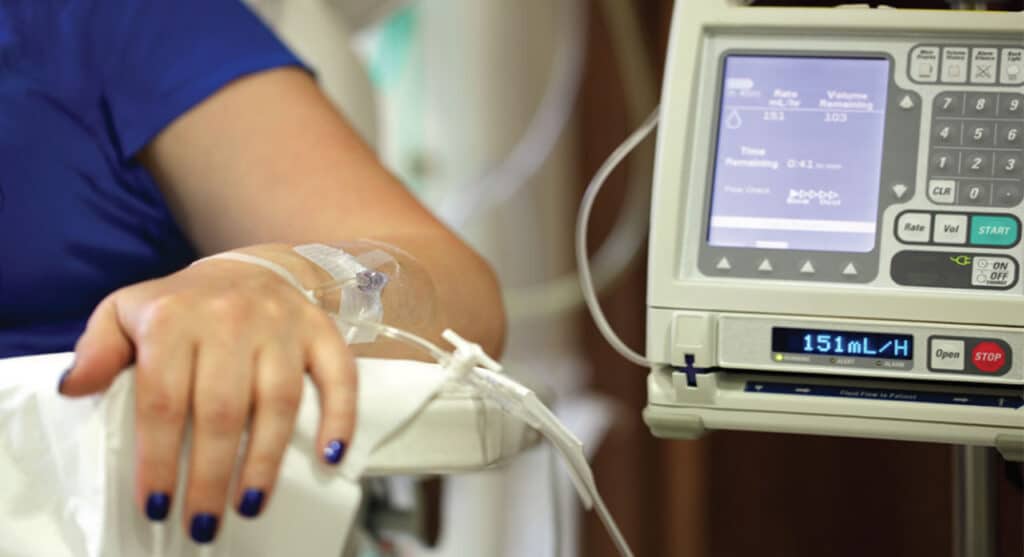
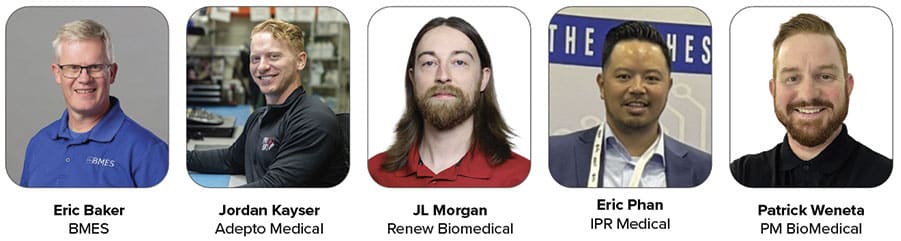
This month, TechNation invited experts to share their insights regarding infusion pumps. The panel was asked a range of questions from common issues to software issues, security patches and more. Participants in the Roundtable article on infusion pumps are:
• BMES Senior Depot and Logistics Manager Eric Baker
• Adepto Medical Biomed Lead Jordan Kayser
• Renew Biomedical Assistant Biomed Manager JL Morgan
• IPR Medical COO Eric Phan
• PM BioMedical Lead Infusion Pump Technician Patrick Weneta
Q: WHAT ARE THE MOST COMMON SERVICE ISSUES YOU ENCOUNTER WITH INFUSION PUMPS IN YOUR FACILITY OR CLIENT NETWORK?
BAKER: rate accuracy, occlusion errors, battery failures, physical damage and software issues.
KAYSER: The most common service issues are always related to physical damage to the devices. The damage is commonly caused by mishandling the device, such as patients or nurses dropping the pump or by someone poking the screen a bit too aggressively with their favorite ballpoint.
MORGAN: The most common service needs that ReNew sees with infusion pumps involve routine maintenance such as battery replacement, while most repairs can be attributed to wear and tear, device drops and mishandling, and normal component failure, either due to age or extended use of the device.
PHAN: Between the facilities and client networks, IPR Medical supports the most common service issues with infusion pumps which tend to fall into a few consistent categories. One is mechanical wear, such as problems with doors, buttons, and/or moving parts is a frequent concern with high-use devices. Two is alarm malfunctions and sensor-related errors, which can also disrupt clinical workflows and cause unnecessary device downtime. Additionally, software inconsistencies or outdated firmware can lead to performance issues or integration challenges. While the specifics may vary by brand or model, these general trends reflect the day-to-day realities of managing aging infusion pump fleets under heavy clinical use. Our role is to help facilities minimize downtime, maintain compliance, and extend the life of their equipment through reliable repair and service solutions.
WENETA: The most common service issues we encounter are failing pressure sensors, inconsistent flow rates due to worn out pump mechanisms and damaged keypads. We also receive many units that have broken casing and cracked housing. Another issue is incompatible firmware causing connection issues.
Q: HOW HAS PREVENTIVE MAINTENANCE FOR INFUSION PUMPS EVOLVED IN RECENT YEARS, AND WHAT BEST PRACTICES DO YOU RECOMMEND?
BAKER: Diagnostics software tools have significantly improved, allowing the ability to detect and address issues earlier. Maintenance and PM software now help ensure that infusion pumps remain properly calibrated within their required intervals. Additionally, continuous updates provided by OEMs enhance device functionality and ensure compliance with the latest safety standards.
KAYSER: The biggest evolution we have seen is our ability to track repairs performed on each individual device over its lifetime in service with us. For example, if a pump needs a mech replacement but our reporting shows the mech was replaced two times previously, we know to investigate in case there is a different cause for the defective mech. Our reporting is almost like CarFax, but for the medical devices we service.
MORGAN: Original equipment manufacturers (OEMs) are increasingly adopting proprietary preventative maintenance (PM) software solutions, a trend that presents both advantages and challenges within the biomedical field. When OEMs provide access to these tools for end users and third-party service organizations, the PM process is significantly streamlined, as the software is typically designed to follow the most efficient and effective maintenance protocols. However, when access to such proprietary software is restricted, it centralizes all PM activities through the OEM. This can create operational bottlenecks and substantially increase equipment downtime, ultimately impacting clinical workflows and patient care.
PHAN: Preventive maintenance for infusion pumps has come a long way in recent years. It used to be more reactive, something you’d do when a device started acting up or hit a calendar deadline. Now, with better tracking systems and more awareness around patient safety, it’s become a lot more proactive. At IPR Medical, we always recommend sticking to manufacturer guidelines, but we also encourage facilities to tailor their PM schedules based on how their devices are used. One pump might need servicing sooner than another depending on how often it’s being used. A few best practices we see working well include standardizing your PM checklists, keeping detailed records of every service, and rotating pumps through maintenance on a regular cycle and not just once a year. At the end of the day, good preventive maintenance isn’t just about compliance, it’s about keeping devices safe, reliable, and ready when patients need them most.
WENETA: We’re seeing increased use of PM tracking software and RFID trackers on units. These tools help find the units and provide an alert when the unit is due for PM. The best practices are recalibrating flow rates and pressure sensors, documenting all PM steps digitally to ensure traceability and accountability.
Q: WHAT CHALLENGES DO YOU SEE WITH MANAGING SOFTWARE UPDATES AND SECURITY PATCHES ON NETWORKED INFUSION PUMPS?
BAKER: Among third-party service providers, staying current with software updates and security patches can be challenging due to limited access to OEM support and proprietary tools. This can delay critical updates, increase cybersecurity risk, and make compliance with regulatory standards more difficult.
KAYSER: There are always challenges with all the different software and options for all types of medical equipment, including pumps. We do a very thorough job of recording the specific options and software each device comes into our facility with. This way, not only can we verify what that specific device was set to when we received it, but more importantly, we know exactly how to set it up when it is returned to the customer. When the customer sends in their next service device, it could be one we have not seen before. By documenting at the level we do, we now know what settings they prefer without asking the customer. We will certainly verify with the customer, but this eliminates a step for the customer and improves their overall service experience.
MORGAN: Some OEMs leverage software updates as a means to control access to the servicing of their equipment. In these cases, OEMs are restricting third-party service providers and end users from obtaining necessary software updates, thereby limiting their ability to independently maintain or upgrade devices. This restriction becomes particularly problematic when a software version is rendered obsolete or subject to a recall. In such instances, healthcare providers may be forced to remove critical devices from service while awaiting OEM intervention, leading to potential disruptions in clinical operations and delays in patient care.
PHAN: One of the biggest challenges is just keeping up. A lot of infusion pumps out there are still running on older platforms and getting them updated isn’t always as simple as clicking a button. There’s also the issue of scheduling, because these devices are in constant use, so finding the right time to take them out of circulation for updates without disrupting patient care is tricky. And then there’s cybersecurity, hospitals are more connected than ever, so any delay in patching can leave devices vulnerable. It really comes down to coordination between biomed, IT, clinical teams, and vendors. Everyone must be on the same page, and that doesn’t always happen as smoothly as you’d hope. That said, more hospitals are starting to treat medical device cybersecurity as part of their core IT strategy, which is a step in the right direction.
WENETA: The challenges we see are timing and coordination with vendors to assist with the software updates and security patches. Many of these devices require manual updates which are labor intensive and can cause delays.
Q: IN YOUR EXPERIENCE, WHAT ARE THE MOST CRITICAL SAFETY CHECKS HTM TEAMS SHOULD PRIORITIZE DURING ROUTINE INSPECTIONS AND REPAIRS?
BAKER: Functionality and performance testing to ensure the equipment operates according to requirements. Electrical safety checks and cleanliness inspections.
KAYSER: Checking the motor/mech for full functionality is very important, but besides the obvious, verifying that the pump works on battery power is critical. Some devices have no obvious indicator that the battery is not working or, even worse, will power on with battery power but lose all motor function. If a pump has no backup power and then gets unplugged during an infusion that is no bueno. An extremely important step for our technicians and quality control is checking for function on exclusively battery power.
MORGAN: No single check should be considered more critical than another. Both OEM and FDA guidelines emphasize the importance of a comprehensive and systematic approach to preventative maintenance. Each step in the process plays an integral role in ensuring device safety, performance and regulatory compliance. Prioritizing certain steps over others can lead to oversight, increasing the risk of missed issues – particularly those that may initially appear minor but could compromise functionality or patient safety over time.
PHAN: First off, alarms and sensor accuracy are huge. If the air-in-line or occlusion sensors aren’t working right, that’s a serious patient safety risk. You want to make sure all the alarms are triggering when they should, not going off randomly, and not staying silent when they shouldn’t. Flow rate accuracy is another big one, even if it’s just a small drift over time, it can make a big difference in dosing, especially with critical meds. Lastly, battery health is another thing we see overlooked sometimes, but it’s super important, especially in facilities that move pumps around a lot or rely on them during transport. A weak battery can lead to shutdowns at the worst times. And don’t forget the basics like power cord integrity, leak tests, and making sure the pump is physically in good shape, no cracked casings or loose parts.
WENETA: Safety checks should prioritize alarm functionality, occlusion detection, air-in-line sensor accuracy, and electrical safety testing. Calibration of flow rates is essential, as even slight variances can impact patient outcomes. It’s also critical to verify the integrity of all infusion pumps.
Q: HOW ARE YOU ADDRESSING SUPPLY CHAIN OR PARTS AVAILABILITY CHALLENGES?
BAKER: With the hurdles we’ve experienced, having qualified and ISO certified companies to purchase parts from has become instrumental in performing quality repairs and reducing down time from units being out of service.
KAYSER: We use a bit of a brute force approach here at Adepto and buy, buy, buy. We try to stay extremely overstocked on all our important parts and devices. We rarely struggle to source parts we need.
MORGAN: At Renew Biomedical, we utilize high-quality aftermarket and refurbished parts as part of our service strategy. This approach provides greater flexibility in addressing supply chain disruptions and helps reduce equipment downtime while also offering cost-effective solutions for our customers without compromising the reliability or performance of the devices, thereby supporting both operational efficiency and budget-conscious healthcare delivery.
PHAN: At IPR Medical, we’ve had to get a lot more strategic. We’re stocking up on high-failure components and building stronger relationships with multiple suppliers so we’re not relying on just one source. And it’s also about communication. We’re upfront with our clients about lead times and keep them in the loop if there’s a delay. In some cases, we’ll offer loaner units or swap-outs to minimize downtime while we wait on a specific part. Honestly, it’s about being flexible and resourceful. The supply chain may not always cooperate, but we do everything we can to make sure our clients don’t feel the impact.
WENETA: We’ve built strategic relationships with both OEM and aftermarket suppliers. We’ve also stocked frequently used parts in-house to avoid delays. Where we can, we cross-reference compatible components across models to reduce dependency on single sources.
Q: WHAT ELSE WOULD YOU LIKE TO SHARE WITH TECHNATION READERS REGARDING INFUSION PUMPS?
BAKER: Infusion pumps are often easy to overlook due to their widespread use across multiple hospital departments, but they play a critical role in patient care. It’s essential that these devices are maintained to the highest standards of accuracy and reliability. Equally important is ensuring that both the clinical staff operating them and the technicians responsible for their repair are properly trained to support their safe and effective use.
KAYSER: Infusion pumps are the backbone of every hospital and are critical for the day-to-day operations. Most people have either been hooked up to a pump or know a friend or family member that has relied on one. It is very rewarding for me and our team to provide a quality service that is being used to take care of patients every day.
MORGAN: There remains a clear and pressing need to advocate for the Right to Repair within the biomedical industry but keeping a focus on “Repairing Right.” OEM restrictions on service capability can prevent highly qualified third-party ISOs from providing support to customers, while lower-quality ISOs may circumvent restrictions and therefore fail to certify that their services meet OEM performance and safety standards. I believe OEMs should adopt a stance of granting parts and software access to “qualified” third-parties, but require that they meet minimum service standards such as ISO 13485 certification. This can greatly improve the experience for device users without compromising on patient safety.
PHAN: If there’s one thing we’d say to your readers, it’s that the behind-the-scenes work HTM teams do to keep these pumps running – checking alarms, calibrating flow, swapping batteries, really matter. It keeps patients safe and helps the clinical side do their job without interruptions. Also, don’t count out the older pumps. A lot of legacy gear still has life left in it if it’s maintained right. With good PM routines, stock inventory, and solid repair support, you can stretch the value of those devices way further than you’d think.
WENETA: Infusion pumps are some of the most widely used and one of the most important devices in a hospital and clinical setting. It is essential that these pumps are maintained through continuous PMs. Working with vendors and building trusting relationships is key to maintaining clinical efficiency.
