



Sponsored by Innovatus Imaging.
By Ted Lucidi, CBET
Staying ahead in healthcare technology management is all about staying informed and up to date on new developments, trends, procedures and processes associated with current technology. From academia to OEMs to ISOs, organizations which continuously engage in research and development, design, testing, verification and validation have a proven impact on efficiencies, costs and outcomes. For example, organizations involved withdesign, manufacturing and engineering are constantly testing new ideas for products that increase performance, simplify operations, increase workflow efficiencies and reduce costs.
As a premium service provider, Innovatus Imaging is continuously improving upon existing and qualifying new processes. The goal is to not just repair a device and get it working again, but to restore performance and reset the device’s life cycle. Continuous learning is as important as continuous quality improvement in all aspects of health care. Having teams dedicated to testing operational and performance thresholds for ultrasound probes and MRI coils enables the teams at Innovatus Imaging’s Centers of Excellence to develop better methodologies for device repair and inform end users of best practices and processes for care and handling that result in more-favorable, cost-saving outcomes.
Test your ultrasound knowledge by seeing how well you can answer the following three questions.
What is the most frequently reported failure on an ultrasound probe?
Most probes sent-in for repair to our Ultrasound Center of Excellence have a reported problem related to performance (image dropout, image artifacts, etc.). Based on data from over 175,000 probe repairs, the majority of costly performance-related failures are actually preventable.
A strong percentage of performance problems are a result of not addressing one or more minor problems. Now, more than ever, probes are not only cleaned after every use, but exposed to harsh disinfectants. Today, normal wear includes slow and gradual degradation of the seals surrounding the acoustic lens, and separation of the seams that join the various parts of the probe housing. The results are corrosion to the underlying acoustic array and associated electronics, as well as shorted circuits leading to catastrophic electronic failures. It’s vital for sonographers to perform frequent visual inspections to every probe in their department, and alert HTM teams of any concerns.
What is the most frequently encountered root cause of an array failure on an ultrasound probe?
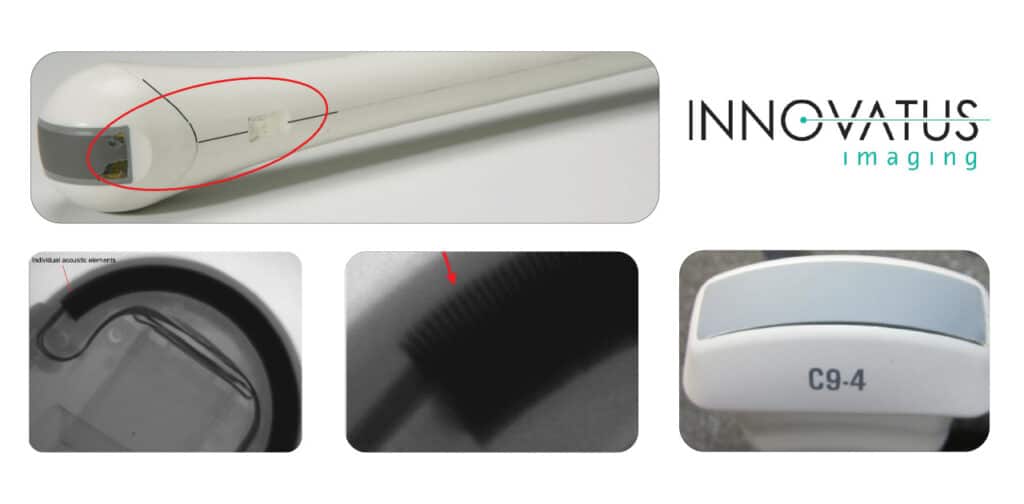
Historically, most professionals believed that the main failure of the acoustic array was performance degradation or just internal failures. Although these are valid root causes, the most common root cause is related to physical damage. Adding to the confusion is the fact that, most times, there is no outward sign of trauma or physical damage to the probe housing.
The thickness of the acoustic elements or “crystals” within the array can be less than 0.5 mm. The majority of acoustic arrays in ultrasound probes utilize PZT (lead zirconate titanate). To the layperson, PZT is a ceramic-like compound. What happens when your ceramic coffee mug falls to the floor? With an ultrasound probe, the force of an accidental fall to the floor is more than enough to induce significant damage to the fragile elements. The result is often dark vertical (hypoechoic) lines in the image.
After evaluating over a quarter-million probes, with a very high degree of confidence, our teams are able to distinguish between an acute failure of the array due to trauma, and array/electronic failures related to normal wear.
What type of disinfectants are best for my ultrasound probe?
Today, for ultrasound probes alone, health care facilities have the ability to choose from over 100 different OEM-approved chemical disinfectants and even more which are not OEM-approved. Each disinfectant has very specific instructions for use (IFUs). Key points include exposure time, application methods and rinsing practices.
You may not know that disinfectants containing alcohols and ammonium chloride solutions can induce significant damage to plastics and rubber materials. And most importantly, you may not know that most of the disinfectants used on ultrasound probes contain these chemicals. The use of alcohols and ammonium chlorides, over time, can lead to excessive stiffness, brittleness, shrinking, and staining of the lens, strain relief, sealants, housings, cable sheathings, etc.
Typically, the choices that end-users have, for disinfectants are limited by supply chain in combination with the infection control department. These departments may be more focused on efficacy and cost than on the effects to the medical devices on which the disinfectants are used. Even OEM-approved chemicals (and the methods in which they are used) have the potential to affect materials over time. It’s important to work with supply chain and infection control to source OEM-approved disinfectants with little to no alcohol and ammonium chloride content and be sure that end-users are following the recommended practices.
Innovatus Imaging is an FDA-registered manufacturer of ultrasound probes for several prominent OEMs. Whether through device manufacturing or depot repair, the above insights and practices add up to data-driven repair methodologies as a result of years of research, design, testing and successful outcomes. The results are proven repair solutions designed to restore the performance of your ultrasound probes and MRI coils at a cost much more budget-friendly than an exchange or replacement.
