



Asset tracking is the foundation of a real-time locating system (RTLS). Its facility-wide nature sets the stage for how RTLS can be scaled across a health system to deliver value for additional use cases such as nurse call automation, staff duress and patient flow. When aligning both current and long-term goals with the solutions driven by RTLS, that’s where focused support from an RTLS partner plays a crucial role.
Focused exclusively on healthcare RTLS for more than 30 years, Midmark RTLS and our national network of certified system integrators are dedicated to helping organizations optimize their investment at discovery, launch and beyond. We understand the true key to success is just as much about the right partner and process as it is the technology. We prioritize people by helping organizations plan for the big picture.
Deployed in more than 1,000 facilities across the country, our proven methodology utilizes best practices and performance strategies to build a sustainable RTLS investment. Here’s a peek into our approach.
Step 1: Know Your Workflow
First, we start by understanding your asset management workflow and how it may change with RTLS. For decades, there have been debates about centralized versus decentralized asset management. A centralized approach leans on rounding teams to ensure units are stocked with ready-to-use equipment, or nursing units must request equipment to be delivered when needed. Without RTLS, this is a manual, labor-intensive process that may leave nursing units short on equipment. To save on labor costs, a decentralized approach is often used – each nursing unit manages its own inventory. But because equipment such as IV pumps travel to different units as patients are transferred from Emergency to Surgery, to ICU and Med-Surg, nursing units often lose track of these mobile assets, again leaving units without the equipment they need. Both models can lead to habitual “hoarding” – stashing away equipment where it can be found for patient care but is hidden from biomedical teams who need to maintain it. This creates the perception of equipment being everywhere and nowhere at the same time. Equipment staff knows they should have is nowhere to be found.
There are pros and cons to each approach, but the good news is RTLS brings the accuracy needed to not only maintain your workflow but enhance it. The key is designing the RTLS deployment to support your desired model – both in how the RTLS software supports the workflow and also choosing the right mix of RTLS technologies that provide both accuracy and cost-effectiveness. For more about the right mix of technologies, keep reading for our RTLS Pro Tip.
Step 2: Evaluate System Design
With your workflow goals in mind, we then determine which areas of the facility need asset tracking coverage and the desired level of precision that will be required. Infrared (IR) locating technology is the gold standard for room-level accuracy, but most health systems would agree near-room level location details for assets would suffice. Staff don’t need to know the exact shelf an item is sitting on, but rather a general area, like hallway or closet, is just as acceptable for efficiently locating equipment. Bluetooth Low Energy (BLE) technology fills this need with its three-meter range.
RTLS PRO TIP: The best RTLS strategy addresses the long-term vision by comparing both biomedical and nursing team needs. We continually see biomedical teams choose one RTLS to manage assets, but then nursing needs another level of locating precision to automate nurse call, manage patient flow or improve caregiver safety. Addressing these needs separately, out of separate budgets, is costly to the health system. Hybrid technology is emerging as an innovative solution to meet these diverse needs. Combining IR with BLE, for example, provides hybrid locating technology that is strategic yet cost-effective. IR delivers accuracy where highly precise detail is critical, like patient care areas, while BLE delivers just as reliable location information with near-room accuracy, but is more cost-effective for areas in need of just asset tracking.
Step 3: Innovate with PAR Level Management
Whether you choose centralized or decentralized asset management, we’ll also discuss the option for Periodic Automatic Replenishment (PAR). PAR is not a new concept; however, it is a modern approach to monitor inventory levels. The automation it provides helps relieve biomedical team workloads and ensure asset availability for caregivers.
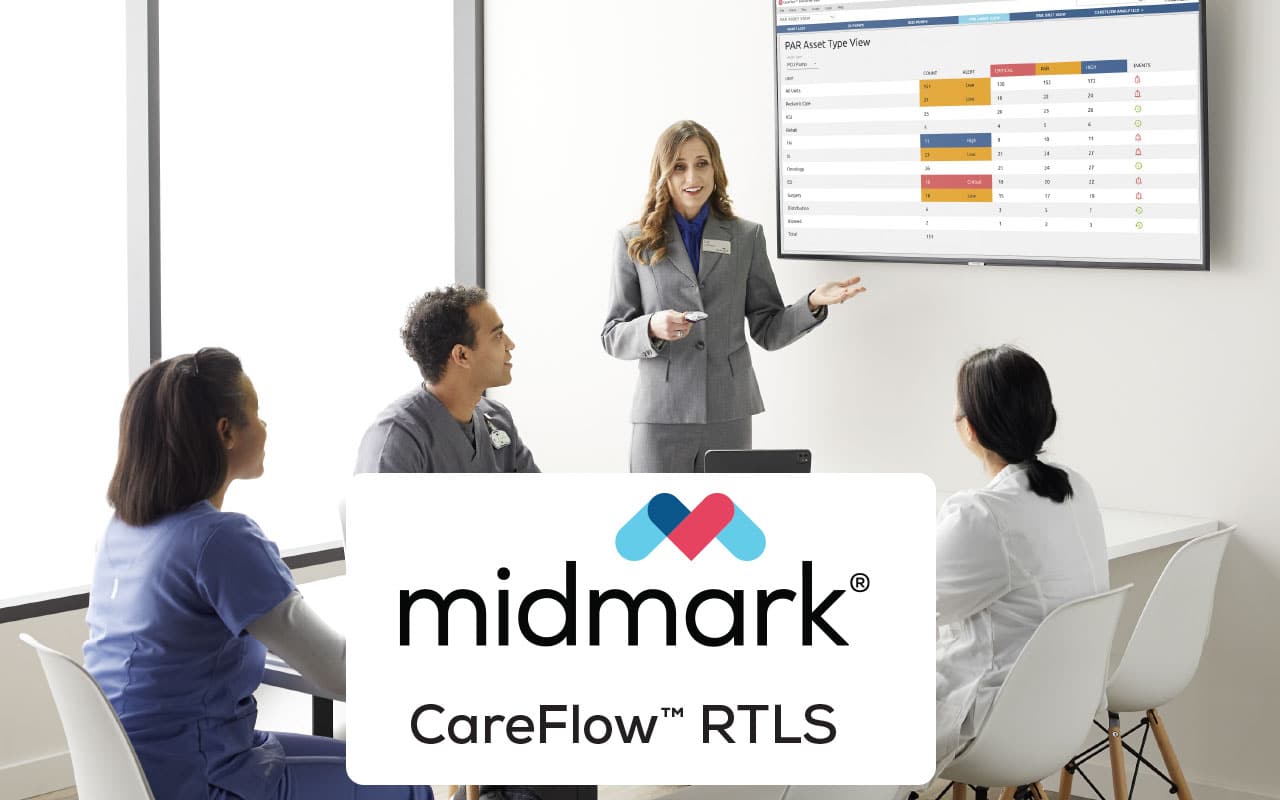
The visualization aspect of PAR allows staff to know at a glance which units are running low or overstocked on key assets. In a centralized model, this alerts the responsible team to take appropriate action to quickly redistribute equipment. In a decentralized model, PAR keeps nursing teams in sync with the inventory in their unit and where they can borrow from if they’re running low. Though not a required component to asset tracking with RTLS, PAR level management can propel efficiency and inventory distribution.
Step 4: Consider Asset + Tag Conditions
Next, before we begin your RTLS project, we help you evaluate the assets you’re looking to track. Those that deliver the highest ROI or have the highest maintenance or replacement costs are often good places to prioritize. These considerations provide a holistic view of how assets should be managed in your RTLS.
Though asset tag placement is often considered later during implementation, it should be brought into the conversation much earlier. Especially for smaller assets that are easily lost or misplaced, like telemetry packs, tags must be small and secure enough, yet just as accurate. The more often tags emit locating signals, the more “real time” your location data will be, but this can come with battery life tradeoffs. Your RTLS partner will help you weigh all options and variations.
Step 5: Incorporate CMMS Integrations
We’ll also want to discuss your CMMS. Biomedical teams primarily work in the CMMS for asset configuration and work orders. Interfacing your CMMS with your RTLS not only centralizes asset data entry to one system, it also provides real-time location information from the RTLS to the CMMS. Biomedical staff can quickly locate assets through the RTLS location field in the CMMS and navigate to the RTLS for a fleet’s real-time information or bigger picture detail. The end result is streamlined tag configuration and management processes and a smoother workflow.
Step 6: Prioritize Insights + Committed Support
Health systems can spend all the time in the world finding the right technology, but RTLS is a journey, not a destination. Midmark RTLS absolutely does the technology right, but it’s our people and decades of experience that make a difference. We and our local partners invest in our customers on day one, and we partner with them throughout their RTLS journey. Customer Success Coaches and local support help analyze data, design best practices and improve processes. We unlock value through deep insights, so that when it all comes together, health systems are empowered to create better patient and caregiver experiences.
Because to us, the experience matters – from assets to workflow to everywhere in between. Our mission is to improve the experience between the patient and caregiver. It’s at the heart of everything we do.
To learn how CareFlow RTLS, along with a dedicated and experienced partner, can turn asset management from “everywhere and nowhere” to “right there,” download our eBook at midmark.com/RTLStracking.
