


By Eric Massey
You already know the technician has a problem. You have known for two weeks. The work orders are late. The documentation is incomplete. The complaints from the nursing unit have started.
But you have not said anything yet.
Maybe you are waiting for the right moment. Maybe you are hoping it corrects itself. Maybe the conversation feels uncomfortable enough that it is easier to look away.
That delay is not kindness. It is a leadership gap.
In HTM, feedback is often delayed until something goes wrong. A missed PM. A customer complaint. A documentation issue. A performance concern. At that point, the conversation becomes reactive instead of developmental.
Strong leadership requires a different approach.
The highest-performing HTM teams do not avoid feedback. They normalize it. Feedback becomes part of the operating culture, not an event reserved for problems.
When handled correctly, feedback strengthens accountability, improves performance and builds trust across the team.
WHY MOST FEEDBACK FAILS
Most feedback conversations fail for one of three reasons:
• The feedback is unclear
• The timing is too late
• The conversation feels personal instead of constructive
In technical environments, leaders sometimes assume people will figure it out on their own. Small issues go unaddressed until they become larger performance problems.
Avoiding feedback does not protect culture. It weakens it. Teams perform best when expectations, coaching and correction happen consistently and professionally.
FRAMEWORK FOR EFFECTIVE FEEDBACK
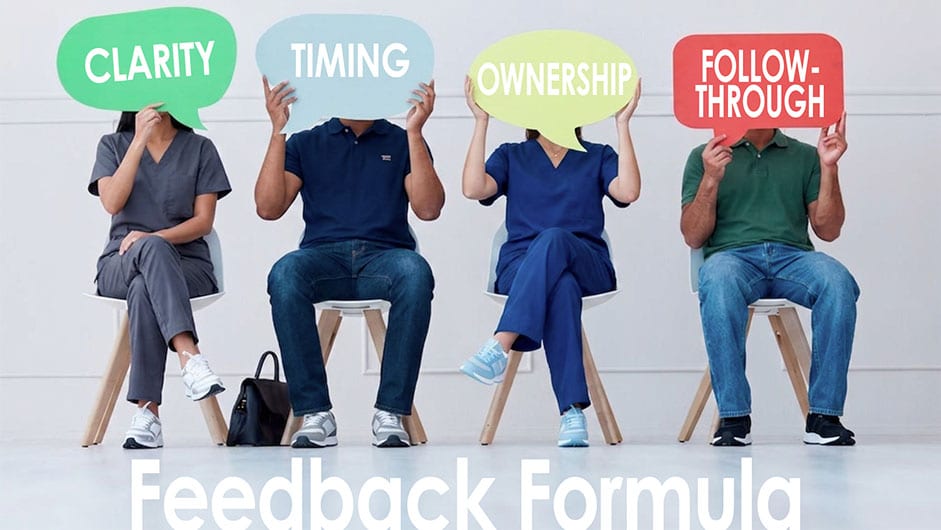
Effective feedback is built on four elements:
• Clarity
• Timing
• Ownership
• Follow-Through
When these four elements are present, feedback becomes productive instead of emotional.
1. Clarity: Be Specific
Vague feedback creates confusion. Don’t use statements like:
• “You need to communicate better.”
• “Be more proactive.”
• “You need to improve accountability.”
These do not create improvement because they lack specificity. Strong feedback identifies the behavior, the impact and the expected adjustment.
Clear feedback sounds like: “The work order documentation was submitted two days late, which delayed reporting visibility for the customer. Moving forward, documentation needs to be completed before the end of each shift.”
Clarity removes defensiveness and creates direction.
2. Timing: Address Issues Early
Delayed feedback reduces effectiveness. The longer a behavior continues, the more difficult it becomes to correct. Early conversations prevent small issues from becoming normalized patterns.
Timely feedback also builds trust. Teams respect leaders who address issues directly and consistently instead of waiting until frustration builds.
Recognition works the same way. Positive feedback should also happen quickly and specifically.
People repeat what gets recognized.
3. Ownership: Make Feedback a Conversation
Feedback should not feel like a lecture. Strong leaders create dialogue:
• “What are you seeing from your perspective?”
• “What barriers are contributing to this?”
• “What adjustment do you think needs to happen?”
Ownership increases when individuals participate in the solution instead of simply receiving correction.
The objective is not to win the conversation.
The objective is improvement.
4. Follow-Through: Reinforce the Standard
One conversation rarely changes behavior permanently. Leaders must follow up:
• Review progress
• Reinforce improvement
• Address continued gaps if necessary
Without follow-through, feedback loses credibility. Standards become optional.
Consistency is what turns feedback into accountability.
FEEDBACK & CULTURE
The way leaders handle feedback shapes team culture.
In weak cultures:
• Feedback is avoided
• Frustration builds quietly
• Accountability becomes inconsistent
In strong cultures:
• Feedback is normal
• Expectations are clear
• Improvement is continuous
Teams grow faster when coaching and correction happen consistently, professionally and without emotion.
RECEIVING FEEDBACK MATTERS TOO
Strong leaders do not just give feedback well. They receive it well.
Leaders who become defensive shut down communication. Over time, teams stop raising concerns, sharing ideas or identifying risks early.
High-performing leaders actively ask:
• “What can I improve?”
• “What obstacles am I creating?”
• “Where can we operate better as a team?”
Leadership growth requires the humility to hear difficult truths without reacting emotionally.
FINAL THOUGHT
In HTM, performance improves when conversations improve.
Feedback is not about criticism. It is about clarity, accountability and growth.
When leaders address issues early, communicate directly and create ownership around improvement, feedback stops feeling uncomfortable and starts becoming part of how the team operates.
The strongest teams are not the ones without problems.
They are the ones willing to have honest conversations early enough to solve them.
That is not a soft skill.
That is the standard.