


Sponsored by Innovatus Imaging

By Ted Lucidi

Last month, we presented information on a commonly encountered image quality issue in the clinical environment. Whether you prefer the term EMI, RFI, or environmental noise, the manners in which Radio Frequency Interference can affect image quality can cause clinicians great frustration. As a former in-house service engineer supporting diagnostic ultrasound, I found these issues to be the most time-consuming and most-frustrating, but the most-rewarding when solved.
Since 2000, Innovatus has successfully repaired over 185,000 ultrasound probes. As part of our data-driven repair processes, we track and trend data such as reported problem, modes of failure, root cause, corrective action, and when the failures occurred in the probe’s life cycle.
I thought that it would provide some relevance and credibility if I shared just how common this issue is. Since the writing of last month’s column (less than 30-days ago), Innovatus has evaluated hundreds of ultrasound probes. Over 60 probes, in 1-months’ time, had a reported problem of “noise artifacts.” With a high degree of confidence, we can say that less than 5% of probes sent in, with a reported problem of noise artifacts, actually have a hard, internal failure affecting noise sensitivity.
Of the fractionally small segment which were probe-related, failures to the shielding were the primary root cause. Examples are:
- Assemblies designed to secure braided shielding have loosened over-time.
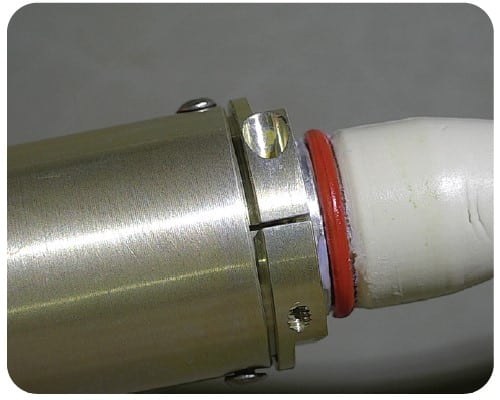
- Set screws, securing shielding within the handle of a TEE probe have loosened.
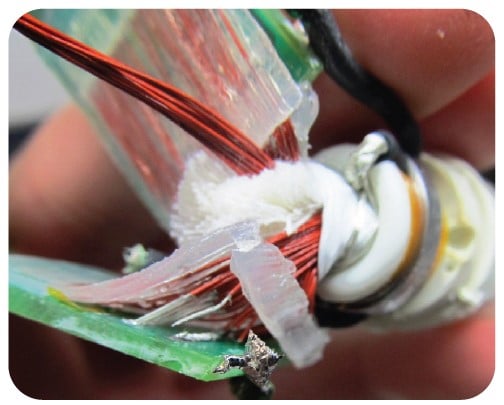
- Accidental cable pulls have broken braided shielding from an internal ground plane within the connector electronics or scanhead electronics.
- Cable roll-over damage has compromised the integrity of the braided shielding within the wiring harness.
- Trauma to the scan head has broken solder joints of copper shielding surrounding the scanhead electronics and acoustic array.
Based on our data, greater than 95% of the reported noise artifact issues would be non-probe-related factors. Following are some real-world scenarios and first-hand experiences that my colleagues and I have experienced in our 30-some years in the ultrasound industry.
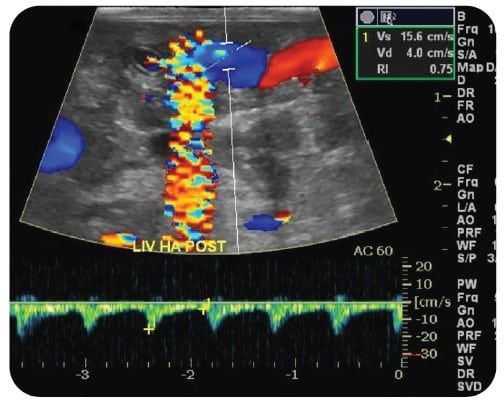
Scenario 1: 1-month of troubleshooting, numerous probes swapped/replaced, scanner hardware replaced, and noise artifact persisted when using a single probe model until someone disconnected the ethernet cable from the rear of the scanner. Findings: A faulty network cable was acting as an antenna and created a pathway for excessive RF noise to enter the scanner. Solution: Replacing the network cable resolved the problem.
Scenario 2: Every time scans were performed in a certain area, noise artifact was present when using a select few probe models. When used in this area, the system was connected to an external monitor via an external video cable (often common in OB/GYN settings). Findings: Visual inspection of the video cable revealed roll-over damage which damaged the braided shielding. Solution: Replacing the cable (or disconnecting the video cable from the scanner) resolved the problem.
Scenario 3: 1-month of troubleshooting, numerous probes swapped/replaced, different scanners swapped into the same location and still, noise artifact appeared sporadically throughout the day, yet consistently each day. Findings: 1-floor above the room where the scans were being performed was a break room. Every time the microwave oven was activated (during break times), noise appeared in the scan image. Solution: Replacing the microwave oven eliminated the problem.
Scenario 4: Multiple months of troubleshooting noise artifact issues at a small outpatient clinic located in a hot, dry, arid location. Findings/Solution: Although the system and probes were in ideal condition and the power cord resistance was within tolerance, the issue persisted. Only when water was allowed to moisten the soil, where the ground rod from the electrical panel was sunk to earth ground, did the problem resolve.
Scenario 5: 3-months and numerous TEE probes swapped/replaced due to intermittent image noise when performing scans in a certain area of the facility. Findings: Behind a wall, in the area where the scans were performed, was an elevator shaft. Every time the elevator passed-by and a scan was taking place, noise appeared in the middle of the image. The issue only occurred when using a TEE probe. Solution: The elevator motor was replaced, and the problem resolved.
Scenario 6: 8-service calls spanning 2 months, until by chance when the service engineer was present, a land line phone 30-feet from the scanner rang, and induced noise artifact. Findings: Every time the phone rang, noise artifact was observed (and only when using one probe model). Other probe models functioned without issue. Solution: The phone was replaced, and the problem resolved.
All strange, but very true scenarios; yet none were related to a failure within a probe. The vast amount of data that we have acquired, combined with the scenarios presented above, suggest that there are multiple variables affecting noise susceptibility within ultrasound imaging and only a small amount may actually be probe related.
Final scenario: In one instance, a customer experiencing intermittent noise artifacts sent their TEE probe in for evaluation and our teams could not duplicate the issue. Over the course of several months, the customer was provided with 3 loaners, and all reported to experience intermittent noise artifacts. Unbeknownst to the customer, Innovatus purchased a factory-new probe and sent it as a fourth loaner. Not surprisingly, that NEW probe was reported to experience intermittent noise artifact.
The teams at Innovatus Imaging understand the challenges with which service engineers and end-users are presented. The leaders at our FDA-registered Center of Excellence for Design and Manufacturing are well-respected subject matter experts in transducer design. Our technical and clinical support team members, each, possess decades of experience in the modality. We continuously support our clients through free evaluations, no-charge next-day loaners, and complimentary technical support.
Next month, in the final article of this series, we’ll present a solid framework to help you troubleshoot those challenging scenarios and we’ll squelch the noise.
Ted Lucidi, CBET, is the director of commercial operations and business analytics at Innovatus Imaging.
